What does your electric heater cost to run?
Keeping a room comfortable shouldn’t mean guessing about the cost. Choose your heater, then add how long you use it and the electricity rate on your bill.
You can change these details whenever you like. The example below is illustrative, not a prediction of your bill.

See also: How much does a 2kW heater cost per hour in the UK? · Electric boiler running cost calculator
Quick answer: a 2kW heater at 26.32p/kWh
Per hour at full power
£0.53
Per day (5 hours)
£2.63
Per month (5 hours × 30 days)
£78.96
Formula: kW × hours × days × unit rate. These figures assume the element draws its full 2kW the whole time. A heater with a thermostat cycles on and off once the room is warm, so real use is often lower — set the thermostat on-time below to reflect that. Unit rate: the current Ofgem price-cap average electricity rate; change it to the rate on your bill.
Model assumptions reviewed June 2026. Default grid electricity and gas rates are labelled with their own Ofgem price cap period where shown. All results are estimates.
Choosing a heater type fills in a typical wattage — you can edit it below.
Watts (W) — a 2kW heater is 2,000W
Decimals allowed (e.g. 4.5)
Share of the time the element is actually drawing power. 100% = full wattage every hour (upper limit).
Pence per kWh (not pounds).
Default: 26.32p/kWh, the Ofgem price cap, 1 Oct 2026 to 31 Dec 2026, Average across England, Scotland and Wales, Direct Debit, single-rate meter; checked 9 Nov 2026. Your own tariff may differ, so change it to the rate on your bill.
Enter the unit rate in pence per kWh (for example 27), not pounds. This tool provides an estimate, not a guaranteed bill amount.
Per hour on
£0.53
Per day
£2.63
Per month (30 days)
£78.96
Per year (365 days)
£960.68
Compare a different heating schedule
Same heater, wattage, thermostat on-time, days and unit rate as above. Only the daily hours change. Your result above stays as it is.
Between 0 and 24 hours.
Current: 5 h a day
£78.96 a month
Alternative: 4.5 h a day
£71.06 a month
Difference
£7.90 less a month
This difference only happens if the heater really uses less (or more) electricity on the new schedule. It is not guaranteed, and a shorter schedule may not keep the room as warm.
Your next step
This is a significant heating cost. Improving insulation, using timers and comparing tariffs can bring it down substantially.
Get an email when the January price cap is announced
Join the free Monday briefing for price-cap news and practical updates for your home.
No spam. Unsubscribe anytime.
Your next step
How the calculation works
kWh per day = wattage ÷ 1,000 × hours on × thermostat on-time. Cost = kWh × your unit rate in pence, then converted to pounds. Monthly cost uses the number of days you enter; annual cost assumes 365 days at the same use, which overstates heating that only runs in winter.
Which electric heaters are cheapest to run?
Direct electric heaters turn almost all the electricity they use into heat, so no type is "more efficient" per kWh. The cost depends on how many kWh it uses, which comes down to wattage, run time and control. Storage heaters can be cheaper only if they charge on a lower off-peak rate, such as Economy 7.
Rated power is not the same as what a heater uses
A heater's wattage is the most it can draw. Most heaters with a thermostat switch the element on and off to hold the set temperature, so once a room is warm they may draw full power only part of the time. How much depends on the room's insulation, the outside temperature and the thermostat setting, so there is no single figure. If you have a plug-in energy monitor or smart plug that measures kWh, use that reading; otherwise treat 100% on-time as the upper limit. Heaters without a thermostat, such as basic fan heaters on a fixed setting, run at full power while switched on.
Example scenarios
Illustrative figures: round numbers chosen to show the method, not current prices. Use the rates on your own bill. Each uses 25p per kWh and 30 days of use a month. The on-time percentages are assumptions for illustration, not measurements: real heaters vary.
| Scenario | Wattage × hours × on-time | kWh a day | Per day | Per month (30 days) |
|---|---|---|---|---|
| Fan heater without a thermostat (no thermostat, so full power while switched on) | 2,000 W × 2 h × 100% | 4.00 | £1.00 | £30.00 |
| Oil-filled radiator, running flat out (upper limit: element never switches off) | 1,500 W × 6 h × 100% | 9.00 | £2.25 | £67.50 |
| Same oil-filled radiator with its thermostat (assumed 50% on-time once the room is warm) | 1,500 W × 6 h × 50% | 4.50 | £1.13 | £33.75 |
| Small panel heater keeping a room warm (assumed 60% on-time) | 500 W × 8 h × 60% | 2.40 | £0.60 | £18.00 |
Worked to full precision and rounded to the nearest penny only at the end. The calculator's yearly figure assumes the same use on all 365 days, which overstates heating used only in colder months.
Electric heaters and heat pumps work differently
Plug-in heaters, panel heaters, storage heaters and electric boilers are direct (resistance) electric heating: each kWh of electricity becomes about one kWh of heat, whichever type you buy. A heat pump moves heat from the air or ground into your home, so it can deliver more heat than the electricity it uses. How much more depends on the system, the installation and the weather. This calculator is for direct electric heaters only; it does not estimate heat pump costs or savings.
For a single heater's hourly cost, see what a 2kW heater costs per hour, and for monthly whole-home figures read how much electric heating costs.
Product we've reviewed · affiliate link
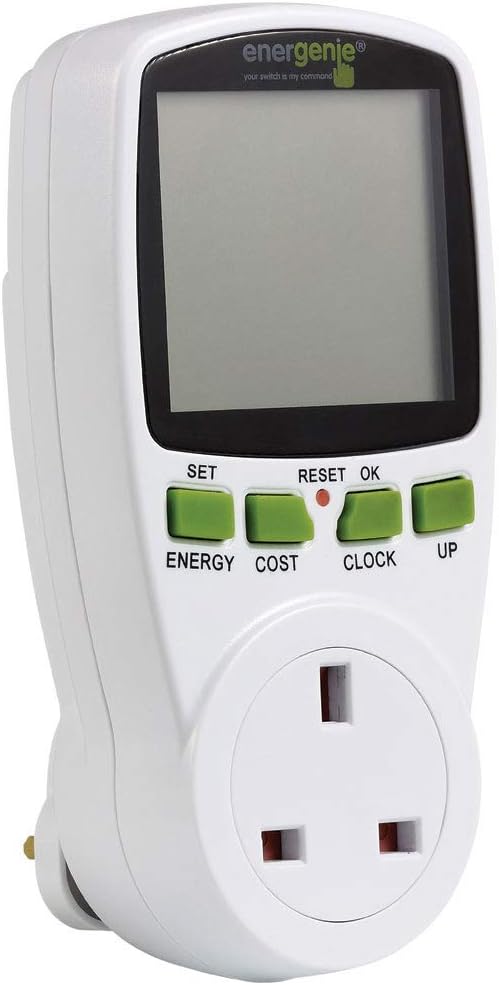
Energenie ENER007 Energy Saving Power Meter
A plug-in power meter that shows the kWh an appliance actually uses, so you can replace the estimate with a real reading.
Check first: confirm its maximum rated load covers your heater's wattage before plugging a heater into it.
As an Amazon Associate PowerGuardian earns from qualifying purchases, at no extra cost to you. Our review is based on product information, not hands-on testing.
Frequently Asked Questions
It uses your heater's wattage, how many hours you run it each day and your electricity unit rate (pence per kWh). It works out the kWh used per day, multiplies by your unit rate and converts to pounds to estimate daily, monthly and annual running costs.
Check the rating label on the heater, the plug or the manual. Wattage is shown as W (watts). If it only lists kilowatts (kW), multiply by 1,000 — for example a 2kW heater is 2,000W. Choosing a preset above fills in a typical figure you can adjust.
Always enter the unit rate in pence per kWh (for example 27), not pounds. Entering it in pounds will give a wildly inaccurate result.
Under the Ofgem price cap, a kWh of electricity costs several times as much as a kWh of mains gas. Even though electric heaters are close to 100% efficient at the point of use, the higher unit rate usually makes them dearer to run than a gas boiler for whole-home heating.
No. It provides an estimate only. Real costs vary with the heater's thermostat cycling, room insulation, outside temperature and your actual tariff. Use it to compare heaters and usage habits, not as a precise bill.