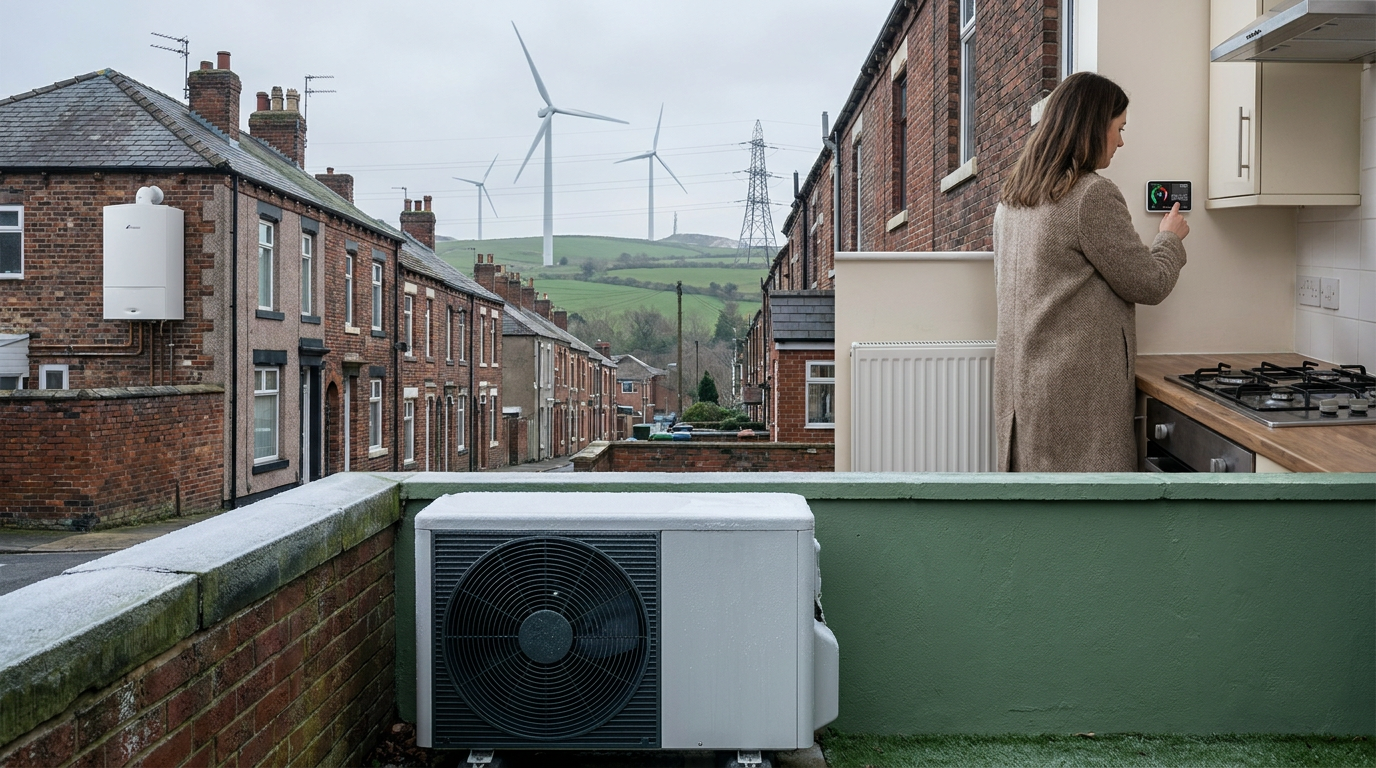
Heat Pumps in the UK 2026: Explained Without the Hype
Heat pumps are unequivocally the UK government's preferred technology for decarbonising domestic heating, acting as a cornerstone of the national net-zero strategy. The increased grant offering through the Boiler Upgrade Scheme (BUS) to £7,500 has indeed spurred a record number of installations in 2026. However, beyond the political imperative and marketing campaigns, a fundamental question persists for a pragmatic UK homeowner: are they actually cheaper to run, and when do they truly make economic and practical sense? The answer, as we'll delve into, is nuanced and rarely as straightforward as some advertising suggests.
Current Supplier Watch
The Engineering Behind the Comfort: How a Heat Pump Works
An air-source heat pump (ASHP), the most common type in the UK, fundamentally operates by exploiting the thermodynamic properties of a refrigerant. Unlike a gas boiler that generates heat through combustion, an ASHP moves heat from one place to another.
Here's a step-by-step breakdown:
- Evaporation (Outdoor Unit): A liquid refrigerant circulates through a coil in the outdoor unit. Even when the outside air temperature is near freezing, there's still latent heat available. A fan draws air over this coil, causing the low-temperature, low-pressure refrigerant to absorb heat and evaporate into a gas.
- Compression: This gaseous refrigerant then enters a compressor. The compressor, powered by electricity, significantly increases the pressure and temperature of the refrigerant. This is where the primary energy input occurs.
- Condensation (Indoor Unit): The hot, high-pressure gas then flows into a heat exchanger coil (condenser) located inside your home (typically within the hot water cylinder or directly plumbed into the heating system). Here, it transfers its heat to the water circulating through your central heating system. As it releases heat, the refrigerant condenses back into a high-pressure liquid.
- Expansion: Finally, the high-pressure liquid refrigerant passes through an expansion valve. This reduces its pressure and temperature, returning it to a low-pressure liquid state, ready to absorb more heat from the outside air, completing the cycle.
This ingenious process allows an ASHP to deliver significantly more thermal energy (heat) than the electrical energy it consumes. For every 1 kilowatt-hour (kWh) of electricity it uses to power the compressor and fans, it can deliver approximately 3 kWh of heat into your home. This efficiency ratio is known as the Coefficient of Performance (CoP). A CoP of 3.0 is a reasonable average for a well-specified and installed ASHP in typical UK winter conditions, though it can vary from 2.5 on very cold days to 4.0+ on milder ones.
Compare this to a modern condensing gas boiler, which achieves around 92% efficiency. This means that for every 1 kWh of gas it burns, it delivers approximately 0.92 kWh of heat into your home. The distinction is crucial: a gas boiler generates heat, an ASHP moves it.
The Bottom Line: Running Costs – Heat Pump vs. Gas Boiler
Understanding the actual cost of putting one unit of heat into your home is paramount. The UK energy market is highly regulated, with the Ofgem price cap dictating the maximum unit rates for electricity and gas for standard variable tariffs. For April 2026 (based on projected trends and current market dynamics which heavily influence the cap):
- Electricity: Approximately 27 pence per kWh (p/kWh)
- Gas: Approximately 6.4 pence per kWh (p/kWh)
Let's break down the cost per kWh of heat delivered:
- Gas Boiler: At 92% efficiency, 1 kWh of gas (6.4p) delivers 0.92 kWh of heat. Therefore, 1 kWh of heat costs 6.4p / 0.92 = approximately 7.0p.
- Heat Pump (CoP 3.0): 1 kWh of electricity (27p) delivers 3 kWh of heat. Therefore, 1 kWh of heat costs 27p / 3 = approximately 9.0p.
_Initial Verdict:_ Without a specialist tariff, a heat pump on a standard variable tariff is currently a touch more expensive per unit of heat than a gas boiler. This differential has been a significant barrier to adoption.
The Game Changer: Heat Pump Tariffs
Recognising the need to incentivise heat pump adoption, several energy suppliers have introduced dedicated "heat pump tariffs" or "smart tariffs" designed to offer cheaper electricity, often during off-peak windows. These tariffs are key to unlocking the economic benefits of heat pumps.
Let's consider a hypothetical but increasingly common heat pump tariff where the average blended electricity price is around 15p/kWh (e.g., Octopus Flux, specific versions of Agile Octopus, or Eon Next Drive/Fixed with heat pump add-ons).
- Heat Pump on specialist tariff (CoP 3.0): 1 kWh of electricity (15p) delivers 3 kWh of heat. Therefore, 1 kWh of heat costs 15p / 3 = approximately 5.0p.
This is where the narrative shifts dramatically. With a specialist tariff, a heat pump can be significantly cheaper to run per unit of heat than a gas boiler. This necessitates careful energy management, potentially programming your heat pump to run more during off-peak hours, but the savings can be substantial.
Running Cost Comparison (per kWh of heat delivered):
| Heating System | Energy Input Cost (per kWh) | Efficiency/CoP | Cost per kWh of Heat Delivered |
|---|---|---|---|
| Gas Boiler | 6.4p (gas) | 92% | 7.0p |
| Heat Pump (Standard Tariff) | 27p (electricity) | 3.0 | 9.0p |
| Heat Pump (Specialist Tariff) | 15p (electricity) | 3.0 | 5.0p |
← Swipe to see more →
The Boiler Upgrade Scheme (BUS) Grant: Is £7,500 Enough?
The Boiler Upgrade Scheme (BUS) is a central pillar of the government's strategy, designed to bridge the upfront cost gap between a gas boiler and a heat pump. The £7,500 grant (for air source heat pumps and ground source heat pumps, and £5,000 for biomass boilers) significantly defrays the installation cost, which can range from £8,000 to £18,000 depending on the complexity, property size, and any necessary upgrades.
Recommended energy saving products
Independently chosen kit that helps UK households cut energy use.

Tapo P110 Smart Plug (Energy Monitoring)
See exactly which appliances are quietly inflating your bill — track real-time watts, kWh and runtime from your phone.
- Real-time energy monitoring
- Cuts standby/vampire power
- Schedule appliances off-peak
Estimated benefit: ~£40/yr standby savings
Shop on Amazon
Home Energy Monitor (Whole-House)
Track your whole-home electricity use live and find where the kWh are going before the bill lands.
- Whole-house live usage
- Spot expensive habits fast
- App history & alerts
Estimated benefit: Awareness cuts ~5-10% use
Shop on Amazon
tado Smart Thermostat Starter Kit
Schedule, zone and remote-control your heating — independently shown to cut heating bills meaningfully.
- Heat only when needed
- Geofencing & schedules
- Room-by-room control
Estimated benefit: Up to ~£140/yr
Shop on AmazonAffiliate links — we may earn a small commission at no extra cost to you. This keeps PowerGuardian free and independent.
When the Grant is a Clear Winner:
- Replacing an Oil or LPG Boiler: If you're currently reliant on oil or LPG for heating, the running costs are typically much higher than mains gas. Oil can fluctuate wildly but is often 10-15p/kWh of heat delivered, and LPG often higher. In these cases, moving to a heat pump, even on a standard electricity tariff, frequently results in immediate and substantial running cost savings. The £7,500 grant makes the financial case almost unassailable, with payback periods often as short as 3-6 years. Furthermore, oil and LPG boilers lack the decarbonisation credentials of heat pumps, making the 'green' argument stronger.
When the Maths is Closer:
- Replacing a Working Mains Gas Boiler: This is the most common dilemma for UK homeowners. If your existing gas boiler has five or more years of life left, and your home is already well-insulated, the decision is more finely balanced. While the grant significantly reduces the upfront cost, the payback period for just the incremental cost difference (after the grant) through running cost savings might still be 8-12 years, _even assuming you switch to a specialist heat pump tariff_. Without such a tariff, the payback could extend beyond the expected lifespan of the heat pump itself, making the investment purely for economic return questionable.
The Role of Property Characteristics:
- Poorly Insulated Homes: This is the heat pump's Achilles' heel. Heat pumps excel at providing a constant, lower-temperature heat output. In a leaky, poorly insulated home (common in much of the UK's older housing stock), the heat loss is so rapid that a heat pump would struggle to maintain comfortable temperatures without being grossly oversized or running inefficiently. This leads to higher electricity consumption, a lower effective CoP, and a significantly longer, if not non-existent, financial payback period. This applies equally to detached Edwardian villas in the South East, as it does to uninsulated pre-1970s semi-detached homes in the North West.
Addressing Common Concerns: Practicalities of UK Heat Pump Ownership
Will a Heat Pump Work in an Old UK House?
Absolutely, and this is a critical point often misconstrued. Many older UK properties dating back to Victorian, Edwardian, or even earlier periods can successfully be heated by heat pumps. The key, however, lies in proper system design and, crucially, addressing the thermal envelope of the property.
- Sizing and System Design: It's imperative that the heat pump is correctly sized for your home's actual heat loss. A detailed heat loss calculation (compliant with MCS standards, a pre-requisite for the BUS grant) will determine the necessary heat output. Oversizing leads to inefficient cycling; undersizing leads to supplementary heating (e.g., immersion heater backup) kicking in too often.
- Radiator Upgrades: Traditional gas boilers operate with high flow temperatures, typically 70-80°C. Heat pumps are most efficient at lower flow temperatures, ideally below 55°C, with a sweet spot often around 45-50°C. This means your existing radiators, designed for high-temperature radiators, may not emit enough heat at these lower temperatures.
- Solution: Often, existing radiators only need upsizing. Instead of a single large radiator, you might install two smaller ones, or a single larger, modern radiator with a greater surface area. This allows the heat pump to operate efficiently at lower flow temperatures while still delivering sufficient heat to the room. This can be a significant cost, however, and is often overlooked in initial estimates.
- Insulation, Insulation, Insulation: We cannot stress this enough. A heat pump rewards well-insulated homes and punishes leaky ones. Comprehensive insulation (loft, cavity wall, external or internal solid wall, and floor insulation) drastically reduces your home's heat loss, allowing a smaller, more efficient heat pump to run at optimal temperatures. This is often the most cost-effective first step to prepare any home for a heat pump. Regional variations in housing stock mean a greater proportion of solid wall properties in areas like London and the South East, which require more expensive external or internal insulation solutions.
Are Heat Pumps Noisy?
This concern is largely a relic of older technology. Modern air source heat pumps are remarkably quiet, thanks to advancements in fan design and acoustic dampening.
- Decibel Levels: Most contemporary units operate in the range of 40-45 decibels (dB) at 1 meter. To put this in perspective:
- A quiet library is around 40 dB.
- A quiet fridge purrs at about 35-40 dB.
- Normal conversation is about 60 dB.
- Permitted Development (PD) Rules: In England, Permitted Development rights (which allow certain works without full planning permission) for air source heat pumps stipulate that the noise level must not exceed 42 dB when measured from the nearest neighbouring dwelling's habitable room window. This regulation effectively pushes manufacturers to design quieter units and installers to consider optimal siting. Local authority planning departments are increasingly vigilant on this, particularly in areas with high housing density.
Do I Need Underfloor Heating?
No, underfloor heating is not a prerequisite for a heat pump installation. While underfloor heating systems (UFH) are an ideal match for heat pumps due to their ability to provide comfortable heating at very low flow temperatures (often 30-35°C), they are certainly not a requirement for an effective heat pump system.
- Existing Radiators: As mentioned, most UK heat pump installations successfully utilise existing radiators, provided they are correctly sized for the lower flow temperature. This often means upsizing some radiators.
- UFH Benefits: If you are undertaking a major renovation or building a new extension, installing UFH alongside a heat pump is an excellent long-term solution, maximising efficiency and comfort due to the large surface area of heat emission. However, retrofitting UFH into an existing home can be disruptive and expensive, often ripping up floors, and isn't typically justified solely for a heat pump.
FAQs
Q1: How much electricity does a heat pump use on average per year in the UK?
This varies wildly based on property size, insulation levels, local climate, and user behaviour. However, for a typical 3-bedroom, semi-detached home in a moderately insulated condition, annual electricity consumption for heating could range from 4,000 kWh to 8,000 kWh. Adding hot water, which heat pumps also do, might add another 1,500-2,500 kWh.
Q2: What is "flow temperature" and why does it matter for heat pumps?
Flow temperature is the temperature of the water circulating from your heating system into your radiators or underfloor heating. Heat pumps achieve their highest efficiency (CoP) when operating at lower flow temperatures. Higher flow temperatures require the heat pump's compressor to work harder, consuming more electricity and reducing its CoP. Achieving a comfortable home with lower flow temperatures is why good insulation and correctly sized emitters (radiators/UFH) are so important.
Q3: Can a heat pump heat my hot water too?
Yes, nearly all domestic air source heat pumps are designed to provide both space heating and hot water. They typically heat a large, well-insulated hot water cylinder indirectly. However, heating water to higher temperatures (e.g., 55-60°C for legionella prevention and general use) can temporarily reduce the heat pump's efficiency compared to space heating at lower temperatures.
Q4: How does the "setback temperature" on a heat pump work?
Unlike gas boilers, which are often turned on and off, heat pumps prefer to run continuously at a lower output to maintain a steady temperature. A "setback temperature" means that instead of turning off completely at night or when you're out, you might reduce the temperature by 1-2 degrees (e.g., from 20°C to 18°C). This prevents the house from cooling too much, meaning the heat pump doesn't have to work as hard (and less efficiently) to bring it back up to temperature later.
Q5: What certifications should I look for in a heat pump installer?
In the UK, it is crucial that your installer is MCS (Microgeneration Certification Scheme) certified. This is a quality assurance scheme that ensures the installation meets high standards and is a mandatory requirement to qualify for the £7,500 Boiler Upgrade Scheme (BUS) grant.
Q6: Are there any regional variations in heat pump performance in the UK?
Yes, broadly speaking, areas with milder winters (e.g., the South West of England) will see slightly better average CoPs than colder, more northerly regions or higher altitudes, as the outside air temperature directly impacts the heat pump's efficiency. However, modern cold-climate heat pumps are designed to perform effectively even when outdoor temperatures drop below zero.
Our Take
The transition to low-carbon heating is inevitable, and heat pumps are a vital part of that future. However, for the UK homeowner in 2026, a pragmatic and clear-eyed assessment is vital.
If your existing boiler has 5+ years of life remaining, your home lacks significant insulation, and you are unwilling or unable to switch to a heat-pump-friendly electricity tariff, then a heat pump, despite the generous £7,500 BUS grant, is unlikely to deliver immediate or short-term financial savings. The payback period for the remaining capital cost could be extended, diminishing the economic argument. In such cases, prioritising insulation improvements should be your first port of call.
Conversely, if your existing boiler is nearing the end of its life, you are currently using an expensive fuel like oil or LPG, your home is already reasonably well-insulated, and you are prepared to embrace a specialist heat pump electricity tariff, then the £7,500 grant makes the investment highly compelling. The combination of significantly reduced capital outlay and lower running costs can translate into genuine long-term savings and a substantial reduction in your carbon footprint.
The future of heating in the UK is electric. Understanding these nuances allows homeowners to make informed decisions that align with both their financial realities and environmental aspirations, moving beyond the hype to a clear understanding of heat pump potential.
Recommended kit
tado Smart Thermostat X
Schedule, zone and remote-control your heating — independently shown to cut heating bills by up to 28%.
Shop on Amazon