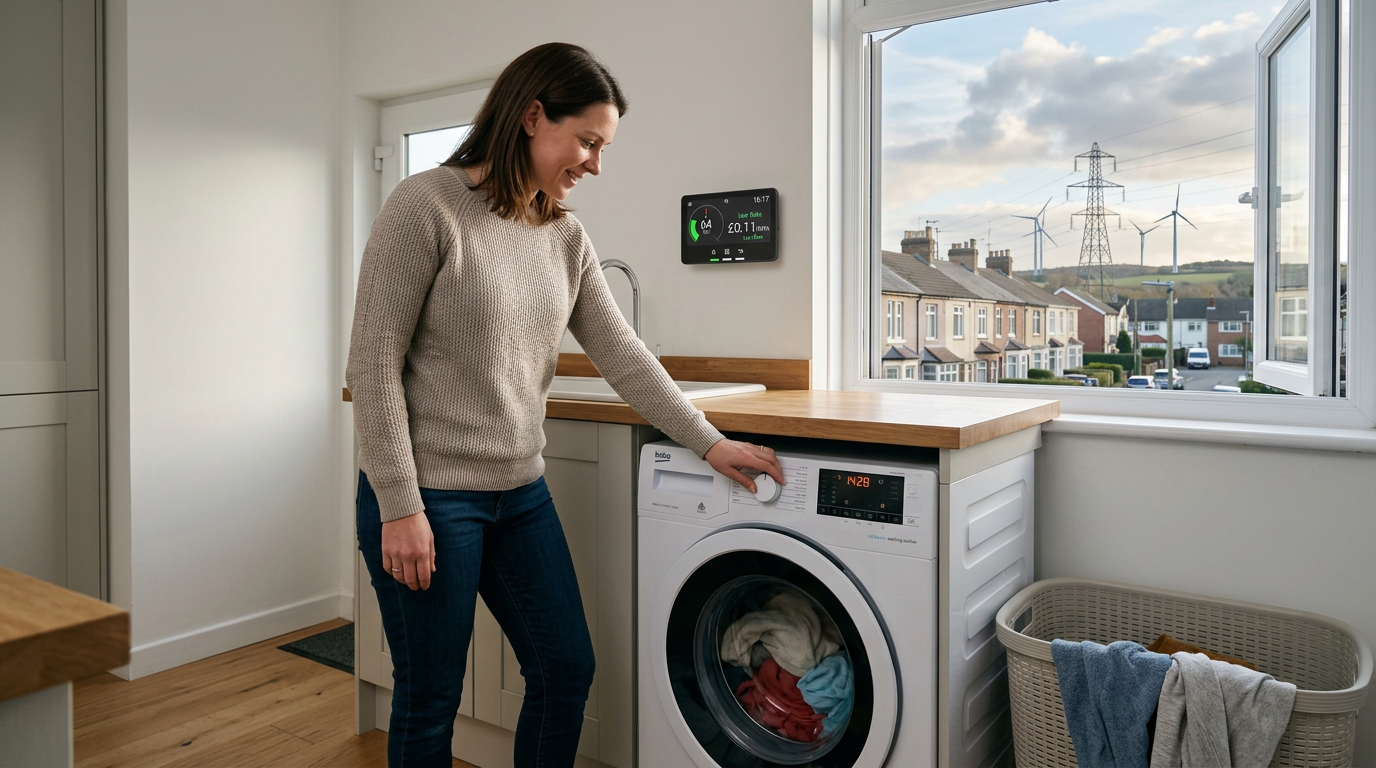
Untangling Your Energy Bills: Finding the Cheapest Time to Use Electricity in the UK in 2026
The UK's energy landscape is dynamic, and with the relentless march towards Net Zero, understanding your electricity usage has never been more crucial – both for your wallet and the planet. For too long, consumers have been accustomed to a flat rate, regardless of when they flicked a switch. However, 2026 is seeing a significant acceleration in the adoption of smart tariffs, fundamentally altering the economics of your daily routines. As a senior energy journalist at Power Guardian UK, I’m here to guide you through the intricacies of these tariffs and reveal how you can significantly reduce your electricity bills by strategically shifting your consumption.
The premise is elegantly simple: electricity generation fluctuates throughout the day. Renewable sources like solar plummet after sunset, and wind generation can be intermittent. To balance the grid, the National Grid ESO needs predictable demand. Smart tariffs incentivise consumers to use power during periods of low demand and high renewable generation (often overnight or during sunny afternoons) and discourage use during peak demand (typically early evenings). This isn't just about saving money; it’s about optimising grid stability, reducing reliance on fossil fuel 'peaker' plants, and ultimately, driving down the overall cost of electricity for everyone.
The Rise of Smart Tariffs: Beyond the Standard Variable Rate (SVR)
While the vast majority of UK households are still on Standard Variable Tariffs (SVRs), regulated by Ofgem's price cap, 2026 is witnessing a rapid expansion of smart tariff offerings. The SVR provides a predictable, albeit often higher, unit rate that rarely changes throughout the day. For example, as of early 2026, the Ofgem price cap for electricity in typical regions like the South East might still hover around 28-32 pence per kWh (p/kWh) for the unit rate, with a daily Standing Charge of around 50-60 pence. This means a 1.5kW washing machine running for 2 hours would consistently cost you approximately £0.90 - £0.96, regardless of when it's switched on.
However, smart tariffs, which require a smart meter, break this mould. They introduce time-of-use pricing, where the cost per kWh varies, sometimes dramatically, throughout a 24-hour cycle. This is where the real savings, and the need for strategic planning, come into play. Let's delve into the specifics of some popular options, factoring in typical 2026 price trends.
Deeper Dive into Specific Smart Tariffs in 2026
#### Octopus Agile: The Dynamic Dynamo
Octopus Agile is perhaps the most well-known and often the most volatile of the smart tariffs. Its prices change every 30 minutes, reflecting the wholesale price of electricity. This means it can offer incredibly cheap, sometimes even negative, rates during periods of high generation and low demand, but also extremely expensive rates during peak times. While the existing content offers a good snapshot, let's expand with more detail and regional context.
- Cheapest Window: 1am–4am (Often 2–8p/kWh)
- Detail: This is the golden hour for Agile users. During these deep overnight hours, industrial demand is at its lowest, and renewable generation (particularly wind, which often blows stronger at night) can be abundant. We've seen rates dip as low as 2p/kWh, especially in regions like Scotland where wind farms are prevalent, or 3-5p/kWh as a common average across England and Wales. Occasionally, particularly on very windy nights with low demand, rates can even go negative, meaning Octopus pays you to take electricity off the grid. This is rare but fantastic when it happens!
- Practical Example: Charging a 75kWh EV battery from 0-100% at an average of 5p/kWh would cost £3.75. On a standard tariff at 30p/kWh, it would be £22.50 – a massive saving.
- Pricier Shoulder: 10am–3pm (~14–18p/kWh)
- Detail: While not as cheap as overnight, this midday period often benefits from strong solar generation. If you have solar panels yourself, this period becomes largely irrelevant for your internal consumption, but for those without, it's a decent time to run appliances if you missed the overnight window. It's significantly cheaper than the evening peak, but requires vigilance as prices can still fluctuate.
- Regional Nuance: Southern regions of the UK, with higher solar irradiation, might see more consistently lower rates during these hours compared to, say, the North East on a cloudy day.
- Peak: 4pm–7pm (Often 28–35p/kWh, frequently higher)
- Detail: This is the forbidden zone for Agile users. As people return from work, turn on heating, cook dinner, and plug in electronics, demand surges. Renewable generation might be waning (solar has set), and gas-fired power stations ramp up. Prices often mirror, or even exceed, the SVR price cap during these hours. We’ve frequently seen rates climb to 35p/kWh, and on particularly strained days, they can hit the 50-60p/kWh mark in certain areas, particularly around London and the South East where demand density is highest.
- Warning: Running a tumble dryer during this period would be financially painful. A 2.5kWh tumble dryer running for 2 hours during peak could cost £1.40 - £2.00, compared to £0.10 - £0.20 overnight.
- Late Evening: 10pm–Midnight (~12–18p/kWh)
- Detail: As demand tapers off post-peak, prices begin to fall again, offering a more reasonable window for heavier usage before the ultra-cheap overnight rates kick in. This is a good time for last-minute washes or charging devices before bed if you can't quite make it to 1 am.
#### Octopus Go / OVO Charge Anytime: The Predictable Savers
These tariffs are designed for predictability, especially for EV owners. They offer a fixed, low rate during a set overnight window, often alongside a slightly higher (though still competitive) rate for the rest of the day.
- Cheapest Window: 12.30am–4.30am @ 7p/kWh fixed
- Detail: Octopus Go and OVO Charge Anytime (and similar offerings from providers like EDF, ScottishPower, etc.) are ideal for those who prefer certainty over dynamism. A guaranteed 7p/kWh (this rate is typical for 2026, though providers might adjust it annually) during a consistent 4-5 hour window makes planning simple. This is primarily aimed at EV charging but can be used for any household appliance.
- Regional Nuance: The low night rate is typically standard nationwide, but the 'off-peak' window can vary by half an hour for some providers depending on local DNO (Distribution Network Operator) infrastructure. Always check your specific provider's terms.
- Comparison to Agile: While 7p/kWh is fantastic, Agile can sometimes beat it. However, Agile also carries the risk of much higher peak rates. Go/Charge Anytime offers peace of mind.
Recommended Smart Heating Product
Control heating remotely and reduce wasted energy with one of the UK’s most popular smart thermostats.
View on Amazon UK#### Traditional Economy 7/10: The Legacy Off-Peak
While smart tariffs are the future, traditional Economy 7 (and less common Economy 10) tariffs still exist for many UK homes, particularly those with older storage heaters or hot water immersion tanks.
- Economy 7: Offers a cheaper rate for 7 hours, usually overnight (e.g., 12:30am-7:30am or 1:30am-8:30am, depending on your DNO region and provider), and a more expensive rate for the remaining 17 hours.
- Typical 2026 Rates: Off-peak might be around 15-20p/kWh, while peak could be 35-45p/kWh. These peak rates are often higher than SVRs, making careful planning essential.
- Use Case: Excellent for electric storage heaters and large hot water immersion cylinders, which can heat up overnight and store the energy for daytime release. Less flexible for other appliances compared to smart tariffs.
What to Shift: Maximising Your Savings with Practical Steps
The key to unlocking savings is to identify your high-consumption devices and schedule them for off-peak periods. Here’s a breakdown with significantly more detail and step-by-step guidance:
#### 1. Dishwasher (Delay-Start Function Essential) Savings: An average of £30/year* and potentially much more. Step-by-Step:* 1. Load your dishwasher after dinner, as usual. 2. Add detergent and select your desired programme. 3. Crucially, look for the "Delay Start" or "Timer" button. This is often represented by a clock icon. 4. Set the delay for the duration that will ensure it finishes within your cheapest window. For Agile, aim for it to start around 1 am. For Go/Charge Anytime, ensure it runs entirely within the 12:30 am - 4:30 am window. 5. Press start. Example Calculation:* A 2.4 kWh dishwasher cycle costs ~£0.72 on SVR (30p/kWh). On Agile (5p/kWh), it's £0.12. Running it 3-4 times a week, that’s a weekly saving of £1.80-£2.40, equating to £90-£120 annually. The £30/year is a conservative estimate across tariffs and usage habits.
#### 2. Washing Machine (Delay-Start / Overnight) Savings: An average of £35/year*, easily doubled with frequent use. Step-by-Step:* 1. Load clothes and add detergent before bed. 2. Use the "Delay Start" feature to begin the cycle during your cheapest hours (1 am for Agile, 12:30 am for Go/Charge Anytime). 3. A modern washing machine completing a 1.5-2 hour cycle will comfortably finish before 4:30 am. 4. Hang laundry to dry in the morning. Avoid tumble dryers during peak hours if possible. Example Calculation:* A typical 0.5-1 kWh wash cycle costs £0.15-£0.30 on SVR. On Agile (5p/kWh), it's £0.025-£0.05. Five washes a week could save £65-£130 annually.
#### 3. EV Charging (The Biggest Win!) Savings: £400+/year* is a conservative estimate; easily £800-£1200+ for high-mileage drivers. Step-by-Step:* 1. Plug in your EV as soon as you arrive home. 2. Smart Charger App: Use your smart charger's app (e.g., Ohme, Zappi, Wallbox) to schedule charging. Most apps allow you to set specific start times or desired "ready by" times, automatically optimising for the cheapest rates on Agile or ensuring it runs within the Go/Charge Anytime window. 3. Vehicle App: Many EVs also have built-in charging schedules via their companion apps. 4. Crucial: Ensure your car is drawing power only during the cheap window, even if plugged in for longer. Example Calculation:* A driver covering 10,000 miles/year in an EV achieving 3.5 miles/kWh would use ~2857 kWh. * On SVR (30p/kWh): £857.10/year. * On Agile/Go (5p/kWh): £142.85/year. Annual Saving:* Over £700. If you drive more, the savings dramatically increase.
#### 4. Home Battery Charging Savings: £200+/year*, highly dependent on battery size and tariff. Step-by-Step:* 1. Most home battery systems (e.g., Tesla Powerwall, GivEnergy, Solax) come with smart control apps. 2. Set the system to preferentially charge from the grid only during your cheapest off-peak hours (e.g., 1 am - 4 am on Agile or 12:30 am - 4:30 am on Go/Charge Anytime). 3. Configure it to discharge (power your home) during peak hours, avoiding expensive grid imports. Value Proposition:* Maximises solar self-consumption during the day, then cheaply charges from the grid at night to cover peak evening demand.
#### 5. Hot Water Immersion (Economy 7 / Smart Control) Savings: £80–£150/year*, significant for electrically heated water. Step-by-Step:* 1. Economy 7 Users: Ensure your immersion heater is wired to your off-peak circuit. It should automatically switch on during the cheap Economy 7 hours. If you have a separate boost switch, use it sparingly during peak. 2. Smart Tariff Users: If your immersion heater is on a standard circuit, consider adding a smart timer plug (for lower wattage heaters) or a dedicated smart relay/controller (for higher wattage, dedicated circuits). 3. Set the timer to bring your water to temperature during the cheapest overnight window. Modern immersion tanks are well-insulated and will retain heat for many hours. Regional Note:* In areas with softer water, limescale build-up can reduce efficiency over time, making it prudent to get your immersion heater checked annually.
#### 6. Tumble Dryer (Avoid Peak at All Costs) Savings: Potentially £50-£100+/year* if frequently used and shifted. Step-by-Step:* 1. Like washing machines, many tumble dryers now have delay-start functions. Utilise these strictly for overnight during the cheapest grid hours. 2. If possible, air dry clothes frequently. Energy Consumption:* Tumble dryers are energy guzzlers. A heat pump dryer is significantly more efficient than a condenser or vented dryer.
Comparison Table: Smart Tariffs vs. SVR (Typical 2026 Prices)
| Feature | Standard Variable Rate (SVR) (Ofgem Cap) | Octopus Agile (Dynamic) | Octopus Go / OVO Charge Anytime (Fixed Off-Peak) | Economy 7 (Legacy Off-Peak) |
|---|---|---|---|---|
| Unit Rate | ~30p/kWh (flat) | 2p-60p/kWh (variable) | Off-Peak: 7p/kWh, Peak: ~30-35p/kWh | Off-Peak: ~15-20p/kWh, Peak: ~35-45p/kWh |
| Standing Charge | ~55p/day | ~55p/day | ~55p/day | ~55p/day |
| Cheapest Window | N/A | 1 am - 4 am (often negative) | 12:30 am - 4:30 am (fixed) | Varied 7hr overnight |
| Peak Window | N/A | 4 pm - 7 pm (very high, >35p/kWh) | All other hours (~30-35p/kWh) | All other hours (high, >35p/kWh) |
| Best For | Simplicity, low consumption | High EV/battery use, flexible habits | EV charging, predictable savings | Storage heaters, hot water tanks |
| Requires | Any meter | Smart meter + flexible usage | Smart meter + EV charger/battery | Economy 7 meter (older) |
| Risk | No off-peak savings | High peak prices if not managed | Less savings for non-EV flexible use | High peak rate for daytime use |
← Swipe to see more →
Note: All prices are indicative for early 2026 and can change based on wholesale markets and Ofgem announcements. Standing charges also vary slightly by DNO region.
### FAQ
Q1: Do I need a smart meter to get these smart tariffs? A1: Yes, almost universally. Smart meters (SMETS2 specifically) are essential as they send half-hourly readings to your supplier, allowing them to apply time-of-use pricing. If you don't have one, your supplier can usually arrange a free installation.
Q2: What happens if I accidentally use electricity during peak hours on Octopus Agile? A2: You will be charged at the much higher peak rate for that consumption. This is why careful scheduling is crucial for Agile users. Apps and smart home ecosystems can help automate this.
Q3: Are there any benefits to using electricity during the day on smart tariffs? A3: On Octopus Agile, daytime hours (outside 4-7 pm) are often cheaper than the SVR, especially on sunny days due to solar generation pushing wholesale prices down. For Go/Charge Anytime, the daytime rate is typically similar to the SVR, so the benefits are almost entirely focused on the overnight fixed window.
Q4: Can I combine solar panels with a smart tariff? A4: Absolutely, and it's highly recommended! Solar panels reduce your reliance on grid electricity during the day, so you only import from the grid when your panels aren't generating enough. You can then use cheap off-peak grid electricity to charge a home battery or EV overnight, creating immense savings. Agile is especially good here as you export excess generation at market rates.
Q5: What if I don't have an EV or home battery system? Are smart tariffs still worth it? A5: Yes, they can be. Even by consistently shifting your washing machine, dishwasher, and other high-demand appliances (like tumble dryers, slow cookers, bread makers) to off-peak times, you can achieve significant savings. However, the largest financial benefits are undeniably realised by those with EVs or battery storage.
Q6: How do I find out what my specific cheap and expensive hours are? A6: 1. Check Your Supplier's App/Website: Your energy supplier will clearly outline your tariff's specific off-peak and peak hours. 2. Refer to OFGEM: For Economy 7, the exact start and end times can vary by your Distribution Network Operator (DNO). OFGEM provides general guidance on DNO regions and their common Economy 7 windows, but your bill or supplier is the definitive source. 3. Third-Party Apps: Apps like 'OctoWatchDog' for Agile users provide live and forecasted half-hourly prices, helping you track the absolute cheapest times.
Conclusion: Embrace the Power of Knowledge
The days of passively paying for electricity are fading. In 2026, understanding your energy consumption patterns and leveraging smart tariffs is no longer just for the technically minded; it's becoming a mainstream necessity for prudent financial management and environmental stewardship. By making conscious, albeit minor, adjustments to your daily routine – primarily by embracing the delay-start function on appliances and automating EV charging – you can unlock substantial savings.
The figures speak for themselves: hundreds, potentially well over a thousand pounds a year are up for grabs for the average UK household willing to engage with their energy usage. As the UK continues its journey towards a smarter, greener grid, being an active participant in this energy revolution will not only benefit your bank balance but also contribute to a more stable and sustainable energy future for all. Power Guardian UK urges you to take control of your energy destiny. Your wallet, and the planet, will thank you.
What is a smart tariff and how does it differ from a standard tariff?
A smart tariff charges different electricity prices based on the time of day, unlike a standard variable tariff (SVR) which has a fixed unit rate. Smart tariffs require a smart meter and incentivise off-peak usage to balance the grid.
When is electricity cheapest in the UK for smart tariff users in 2026?
For dynamic tariffs like Octopus Agile, the cheapest window is typically 1am–4am, often costing 2-8p/kWh. For more predictable tariffs like Octopus Go, a fixed overnight window (e.g., 12:30am-4:30am) offers the lowest rates.
What is the "forbidden zone" for electricity use on Octopus Agile?
The "forbidden zone" is typically between 4pm–7pm, when electricity prices on Octopus Agile often surge to 28-35p/kWh, and can even reach 50-60p/kWh in high-demand areas. This is due to high demand as people return home and low renewable generation.
Can electricity rates ever be negative on a smart tariff?
Yes, on highly dynamic tariffs like Octopus Agile, rates can occasionally go negative during periods of extremely high renewable generation (especially wind) and very low demand. This means the energy provider effectively pays you to use electricity.
How much more expensive is it to run appliances during peak vs. off-peak times on a smart tariff?
Running a 1.5kW washing machine for 2 hours could cost £0.06 - £0.24 overnight (at 2-8p/kWh), compared to £0.84 - £1.05 during the 4pm-7pm peak (at 28-35p/kWh). This demonstrates a significant cost difference.
Current Supplier Watch
Recommended kit
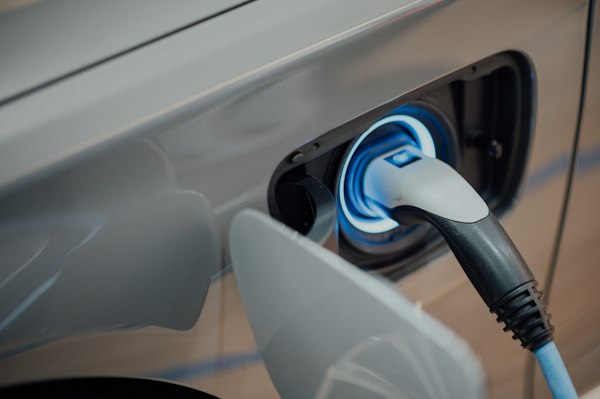
Type 2 EV Charging Cable 7m 32A
Reliable 7m Mode 3 Type 2 to Type 2 cable for public chargepoints — supports up to 7.4kW single-phase charging.
Shop on Amazon