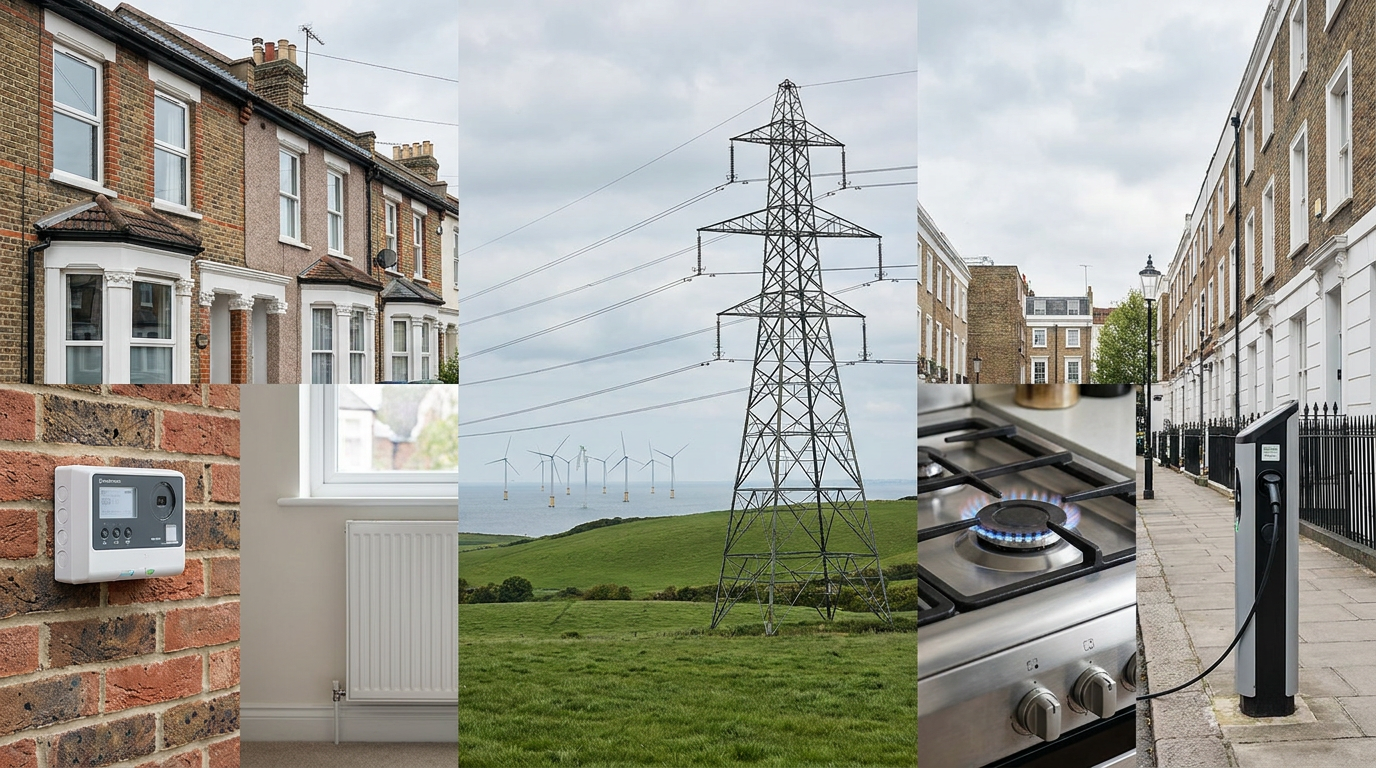
If your energy bill keeps creeping up even though you have not changed how you live, you are not imagining it. UK households now pay around £141 a month on a typical dual-fuel direct debit, and many pay considerably more. This guide breaks down the real reasons your bill is so high — and the practical steps that actually move the needle.
The short answer
UK energy bills are high because:
- Electricity prices are tied to the price of gas, even when most of our power comes from cheaper sources.
- Standing charges have nearly doubled since 2021 and you pay them whether you use any energy or not.
- The price cap is a ceiling, not a target — most people sit very close to it.
- Network, policy and supplier costs make up roughly 40% of every bill.
- Older, poorly insulated UK housing leaks heat faster than almost any other country in Europe.
The rest of this article unpacks each of these and shows you where the real savings are.
Current Supplier Watch
1. The price cap is keeping bills high, not low
Ofgem's price cap was introduced to protect households from being overcharged. In practice, almost every standard variable tariff sits within a few pounds of the cap. So when wholesale prices fall, the cap drops slightly. When they rise, the cap jumps. You feel the increases far more than the decreases.
For the typical household, the unit rates and standing charges set by the cap define what you pay. If you are on a default tariff, you are almost certainly paying the cap.
- Use the Overpayment Checker to see how your bill compares to the fair range for your home.
2. Standing charges — the bill you cannot avoid
Standing charges are the daily fixed fee you pay just for being connected to the grid. In 2021 they averaged around 25p a day. Today they sit closer to 60p a day for electricity in many regions, and higher still in the North of Scotland and Merseyside.
That works out at roughly £220 a year before you switch on a single light. For low-usage households — small flats, single occupants, second homes — standing charges can make up more than half the bill.
- See how your region compares on the Regional Price Map.
3. Electricity is priced like gas, even when it is not gas
This is the single biggest driver of high bills, and the one most people have never heard of. The UK wholesale electricity price is set by the most expensive generator needed to meet demand at any given moment. Most of the time, that is a gas power station — even when wind, solar and nuclear are providing the bulk of the actual electricity.
So when global gas prices spiked in 2022, UK electricity prices spiked too, despite renewables being far cheaper to run. Reform of this "marginal pricing" system has been discussed for years but has not yet happened.
4. Network, policy and supplier costs
Roughly 40% of your bill is not the energy itself. It is:
- Network costs — maintaining the pylons, cables and pipes that deliver energy to your door.
- Policy costs — government schemes funding renewables, insulation grants and support for vulnerable households.
- Supplier operating costs and margin — call centres, billing, smart meter rollout, and a regulated profit margin.
- VAT — 5% on domestic energy.
Some of these are necessary investments. Others are areas where competition between suppliers should be driving prices down — and often is not.
5. UK housing leaks heat
The average UK home is among the leakiest in Western Europe. Single-glazed windows, solid walls, uninsulated lofts and ageing boilers are still common. The result: a UK household can use 50–70% more energy to heat the same space than a comparable home in Germany or the Netherlands.
This is why two households on the same tariff, in the same town, can have wildly different bills. The tariff is only half the story — the building is the other half.
What actually cuts your bill
Not all advice is equal. Here is what genuinely makes a difference, ranked by impact for most households:
- Check you are not overpaying for your tariff. Many households are still on legacy variable deals that are above the cap. Run the Overpayment Checker — it takes 30 seconds.
- Get a smart meter and look at it weekly. Awareness alone typically cuts usage by 5–10%.
- Turn the flow temperature on a combi boiler down to 55–60°C. Free, takes a minute, can save 6–8% on gas.
- Insulate the loft and draught-proof doors and windows. Cheap measures with payback in 1–2 years.
- Switch to a fixed tariff only if it is meaningfully below the cap. Compare on a like-for-like annual basis using the Bill Calculator.
- Check your standing charge. Some suppliers offer "no standing charge" or low-standing-charge tariffs that suit low-usage homes.
When to worry — and when not to
If your bill has jumped suddenly, the most common causes are:
- A direct debit recalculation after winter (very common in March and April).
- A meter reading correction after a long period of estimated bills.
- A tariff rolling off a fix and onto the standard variable rate.
None of these mean you are using more energy. Always check your actual usage in kWh against the previous year before assuming you have a leak or a faulty appliance.
Recommended energy saving products
Independently chosen kit that helps UK households cut energy use.
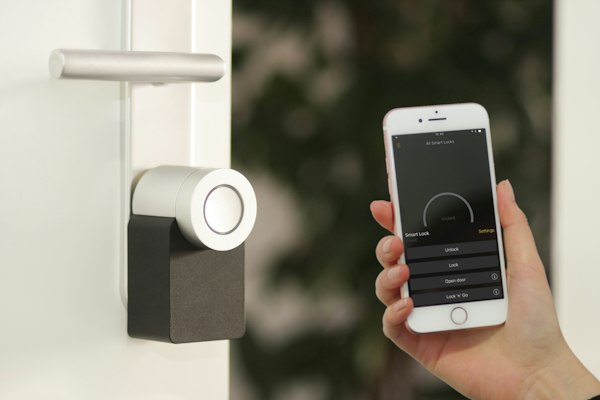
Tapo P110 Smart Plug (Energy Monitoring)
See exactly which appliances are quietly inflating your bill — track real-time watts, kWh and runtime from your phone.
- Real-time energy monitoring
- Cuts standby/vampire power
- Schedule appliances off-peak
Estimated benefit: ~£40/yr standby savings
Shop on AmazonAd – affiliate link. PowerGuardian may earn a commission from Amazon or another approved affiliate partner at no extra cost to you.

Home Energy Monitor (Whole-House)
Track your whole-home electricity use live and find where the kWh are going before the bill lands.
- Whole-house live usage
- Spot expensive habits fast
- App history & alerts
Estimated benefit: Awareness cuts ~5-10% use
Shop on AmazonAd – affiliate link. PowerGuardian may earn a commission from Amazon or another approved affiliate partner at no extra cost to you.
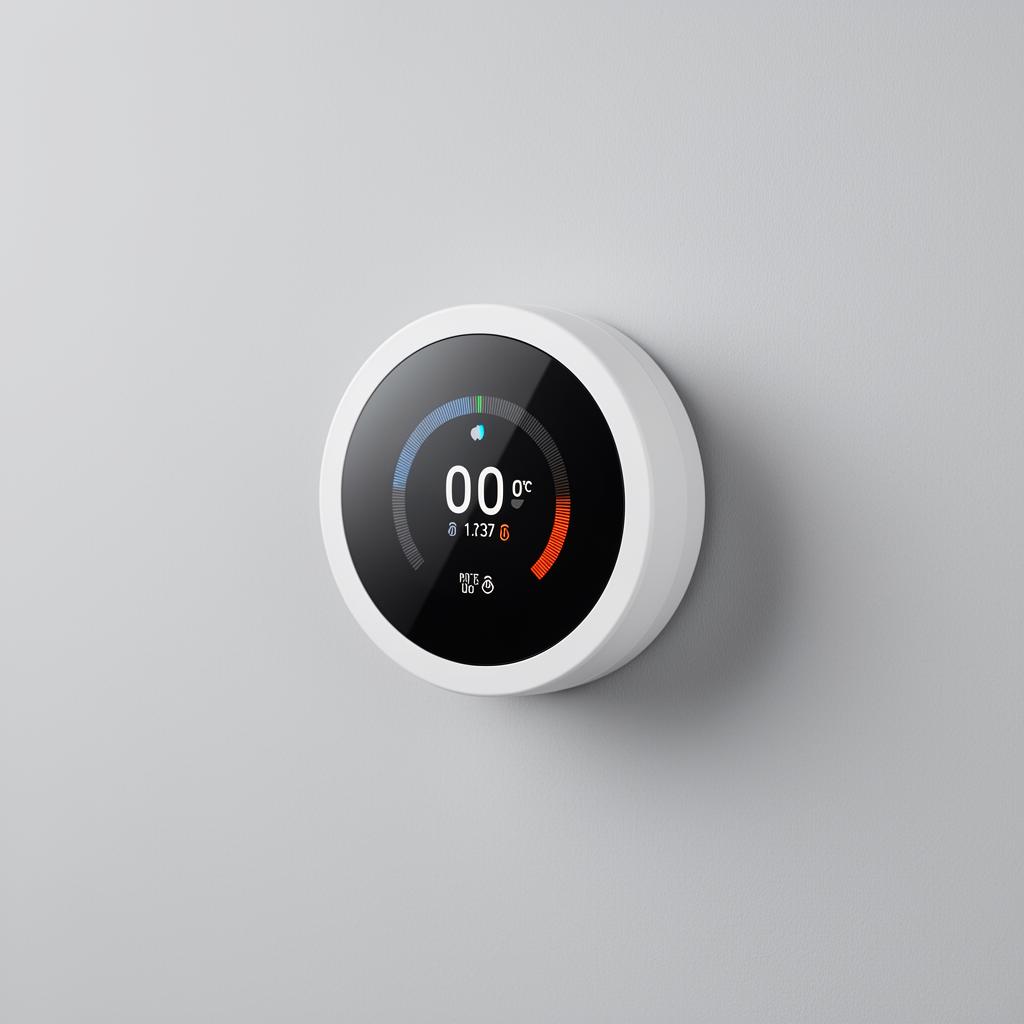
tado Smart Thermostat Starter Kit
Schedule, zone and remote-control your heating — independently shown to cut heating bills meaningfully.
- Heat only when needed
- Geofencing & schedules
- Room-by-room control
Estimated benefit: Up to ~£140/yr
Shop on AmazonAd – affiliate link. PowerGuardian may earn a commission from Amazon or another approved affiliate partner at no extra cost to you.
Affiliate links — we may earn a small commission at no extra cost to you. This keeps PowerGuardian free and independent.
The bottom line
UK energy bills are high for structural reasons that no household can fix on its own — gas-linked pricing, high standing charges, and leaky homes. But within those constraints, a typical household can still cut £150–£400 a year by checking their tariff, watching their usage, and making one or two cheap efficiency upgrades.
Power Guardian UK exists to help you do exactly that. Start with the Overpayment Checker, then look at the Regional Price Map to see whether your area is being charged fairly.
Why are electricity prices so high in the UK, even with more renewables?
UK wholesale electricity prices are often set by the most expensive generator needed, which is usually a gas power station. This "marginal pricing" system means electricity costs rise with gas prices, even when cheaper renewable sources supply most of the power.
What are standing charges and why have they increased so much?
Standing charges are daily fixed fees for connecting to the energy grid, paid regardless of energy usage. They have nearly doubled since 2021, now costing around 60p a day for electricity in many regions, adding up to roughly £220 a year.
Does the energy price cap protect me from high bills?
The price cap acts as a ceiling, not a target, meaning most standard variable tariffs sit very close to it. While it prevents excessive overcharging, it reflects wholesale price increases more sharply than decreases.
How much of my energy bill is actual energy cost?
Around 40% of your energy bill is made up of network costs, government policy charges, supplier operating costs and profit, and 5% VAT. These are separate from the cost of the energy itself.
Why do UK homes use so much more energy for heating than other European countries?
UK housing stock is often poorly insulated, with features like single-glazed windows and solid walls still common. This means UK homes can use 50–70% more energy to heat the same space compared to similar homes in countries like Germany or the Netherlands.
Recommended kit
Door Bottom Draught Excluder
Block cold draughts under exterior doors — one of the cheapest wins for cutting winter heating loss.
Shop on Amazon